


What is contemporary bouquet design: a 2026 guide
TL;DR:
- Contemporary bouquet design in 2026 emphasizes asymmetry, negative space, and mixed textures over traditional symmetry.
- The Wild Poise trend balances artistic spontaneity with deliberate composition, requiring precise spatial knowledge and skill.
Contemporary bouquet design is defined by loose, asymmetrical, and organic arrangements that prioritise texture, movement, and negative space over traditional symmetry. The industry term for this approach is “free-form floristry,” though “contemporary bouquet design” captures the broader aesthetic shift happening across UK floristry in 2026. The dominant trend this year is Wild Poise, a style that balances artistic spontaneity with deliberate compositional structure. Florist and educator Karen Barnes describes it as arrangements that feel alive rather than static. Blumeflowers works within this aesthetic, producing bouquets that reflect current design thinking while remaining grounded in seasonal, British-grown blooms.
What is contemporary bouquet design and how has it changed in 2026?
Contemporary bouquet design breaks from the tightly packed, dome-shaped arrangements that defined floristry for decades. Loose, organic silhouettes with intentional asymmetry and varied stem heights now define the leading edge of UK floral design. This shift is not simply aesthetic. It reflects a broader change in how people think about flowers: less as decoration, more as art.
The key characteristics that define modern bouquet styles in 2026 are:
- Asymmetrical silhouettes that mimic the way flowers grow in a garden or meadow, rather than a uniform sphere
- Negative space used deliberately between stems to create breathing room and visual tension
- Varied stem heights that give the arrangement depth and a sense of natural movement
- Contrasting textures achieved by mixing dried grasses, seed pods, and woody branches with fresh blooms
- Colour palettes that move beyond pastels into ochres, rusts, sand tones, icy blue, and bleached white
- Foam-free mechanics using chicken wire, tape grids, or weighted vessels instead of floral foam
The departure from symmetry is the most visible change. A traditional bouquet reads as a finished object. A contemporary arrangement reads as a moment caught mid-movement.
Pro Tip: When building a contemporary bouquet, place your tallest stem first and work outward and downward. This anchors the composition and prevents the arrangement from collapsing into a flat, uniform shape.
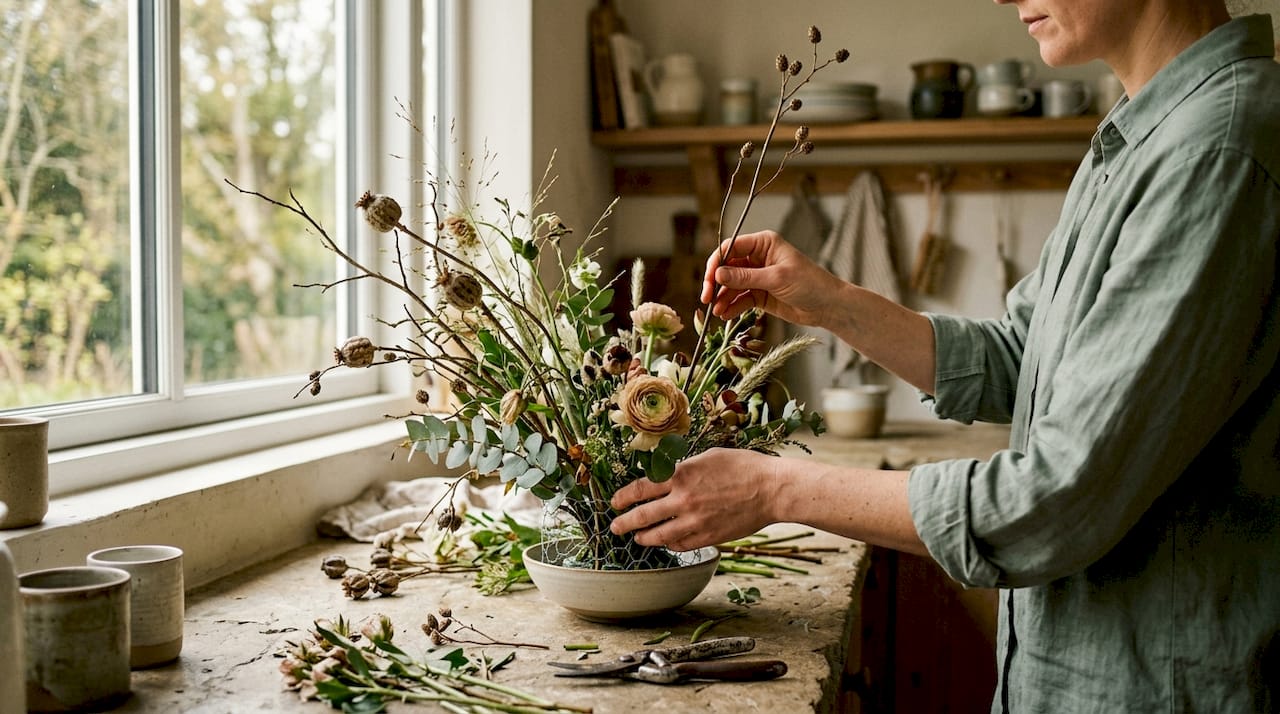
How do contemporary bouquets balance natural spontaneity with deliberate design?
The Wild Poise aesthetic is the defining concept of 2026 floristry, and it is more technically demanding than it looks. Karen Barnes highlights that success depends on spatial composition and the use of negative space to create an editorial feel. The bouquet must look effortless. Achieving that takes real skill.
The process of building this balance follows a clear sequence:
- Choose a structural anchor. Select one or two statement stems, such as a tall grass or an arching branch, to establish the overall direction of the arrangement.
- Vary facing angles. Place flowers so they face different directions. Some look upward, some tilt outward, and some face slightly downward. This creates the sense of natural growth.
- Control stem heights deliberately. Stems placed at varying heights and angles prevent structural collapse and give the garden-gathered aesthetic its authenticity.
- Build in negative space. Resist the urge to fill every gap. Empty space is a design element, not a mistake.
- Check the silhouette from multiple angles. Rotate the bouquet as you work. A contemporary arrangement should look intentional from every viewpoint, not just the front.
“The most common mistake in contemporary floristry is confusing looseness with carelessness. Every stem has a reason for being exactly where it is. The spontaneity is designed.”
This is what separates a truly contemporary arrangement from one that simply looks undone. The appearance of spontaneity requires precise knowledge of natural growth patterns and stem movement. Traditional bouquets are forgiving because symmetry hides errors. Contemporary arrangements are not.
What materials and seasonal choices define modern bouquet styles?
Material selection is where contemporary floral arrangements gain their character. The most distinctive quality of 2026 bouquets is the mix of fresh seasonal blooms with dried grasses, seed pods, and woody branches. This combination adds structural depth and tactile contrast that fresh flowers alone cannot achieve.
The best contemporary florists do not work from fixed flower lists. Top florists choose a cohesive colour palette and texture theme first, then source the freshest available blooms from trusted growers. This approach produces more authentic seasonal expression than prescribing specific varieties months in advance.
Sustainable mechanics are now standard practice in contemporary floristry. Foam-free frameworks using chicken wire, tape grids, and weighted vessels support architectural and organic shapes without the environmental cost of floral foam. This is not a niche preference. It is the direction the entire industry is moving.
| Material type | Role in the arrangement | Seasonal availability |
|---|---|---|
| Fresh seasonal blooms | Colour, fragrance, focal points | Year-round, varies by variety |
| Dried grasses and pampas | Texture, movement, height | Autumn and winter; dried year-round |
| Seed pods and thistles | Structural interest, contrast | Late summer through winter |
| Woody branches and twigs | Architecture, negative space | Autumn and winter |
| Dried citrus or botanicals | Colour accent, tactile detail | Year-round as dried elements |
Working with British growers wherever possible strengthens the seasonal authenticity of a contemporary bouquet. Local sourcing also reduces transit time, which means fresher stems and longer vase life. For modern floral styling inspiration that reflects these material choices, Blumeflowers publishes seasonal guides aligned with each quarter’s best available blooms.
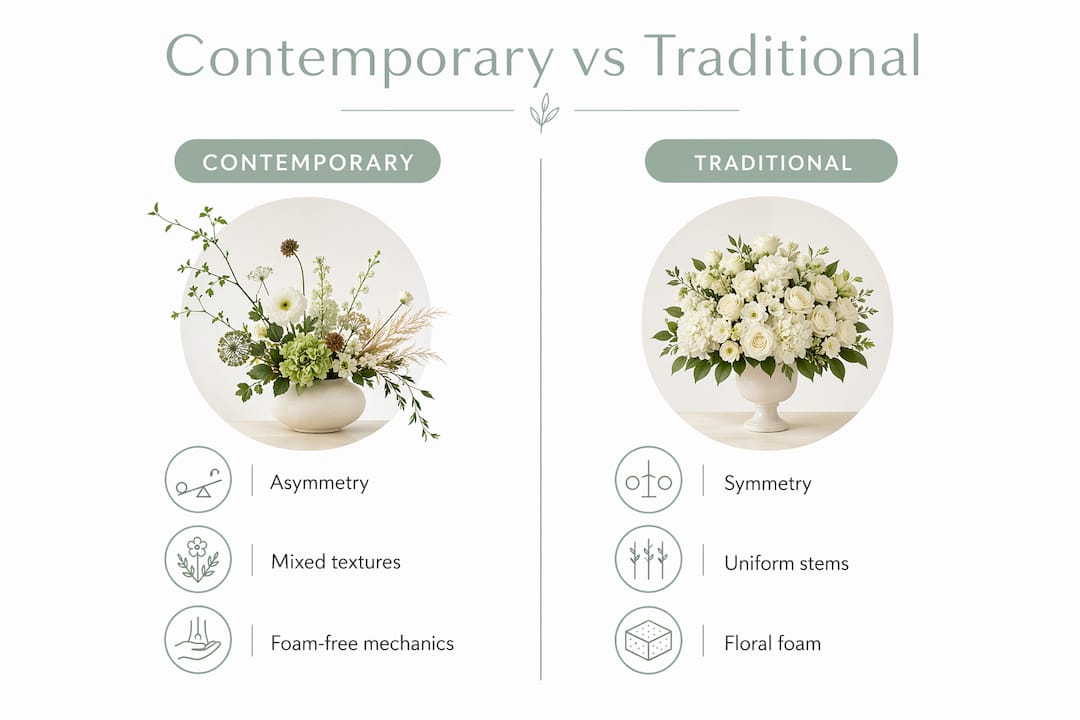
How do contemporary and traditional bouquets differ?
The differences between contemporary and traditional bouquet design go beyond aesthetics. They reflect fundamentally different philosophies about what a bouquet should communicate.
Traditional floral design favours symmetry, uniform stem heights, and a structured dome or cascade shape. Floral foam is the standard mechanical support. The colour palette tends toward matched tones rather than contrasting ones. The overall effect is polished and formal, which suits heritage venues, classic weddings, and ceremonial occasions.
Contemporary bouquets favour asymmetry, movement, bold colour combinations, and sustainable methods over symmetry and floral foam. The result is more artistic and individual, suited to modern events, fashion-forward settings, and anyone who wants their flowers to feel like a personal statement rather than a convention.
| Feature | Contemporary design | Traditional design |
|---|---|---|
| Shape | Asymmetrical, organic | Symmetrical, dome or cascade |
| Mechanics | Foam-free: wire, tape grids | Floral foam standard |
| Colour approach | Layered, contrasting tones | Matched, uniform palette |
| Texture | Mixed: fresh, dried, botanical | Primarily fresh blooms |
| Setting | Modern events, fashion, editorial | Formal, heritage, ceremonial |
| Movement | Deliberate, directional | Static, structured |
Blended approaches are increasingly popular in 2026. These arrangements use classic blooms such as roses and peonies but apply contemporary techniques: asymmetrical placement, varied heights, and foam-free mechanics. The result honours timeless beauty while embracing modern aesthetics. For readers interested in how these principles apply to luxury floral trends, the distinction between styles becomes especially clear in high-end event contexts.
What practical steps help you create a contemporary bouquet?
Creating a contemporary bouquet starts with concept, not flowers. Decide on a colour palette and a texture theme before you select a single stem. Colour palettes work best when they tell a layered story through nuanced, contrasting tones rather than a single dominant colour.
The practical steps for building a contemporary arrangement are:
- Start with your palette and texture concept. Choose two or three tones that contrast rather than match, then identify which textures will carry each tone.
- Select stems for varied heights. Aim for at least three distinct height levels within the arrangement. This creates the depth that makes contemporary bouquets visually interesting.
- Build your foam-free structure first. Use a tape grid across the vessel opening or a chicken wire ball inside the container before placing any stems.
- Place structural elements before focal flowers. Grasses, branches, and seed pods go in first. They establish the silhouette and the negative space.
- Add focal blooms asymmetrically. Place the largest or most striking flowers off-centre. Resist clustering them in the middle.
- Step back and edit. Remove any stem that fills a gap without adding visual purpose. Negative space is part of the design.
Pro Tip: If your arrangement looks too neat, remove one stem entirely. Contemporary design lives in the tension between fullness and space. A single deliberate gap often makes the whole composition read as more intentional.
The garden-gathered aesthetic requires nuanced knowledge of how stems naturally move and angle. Practice with inexpensive foliage before committing to premium blooms. The technique transfers directly once you understand how stems behave at different heights and angles.
Key takeaways
Contemporary bouquet design succeeds when asymmetry, negative space, and mixed textures work together within a deliberate compositional structure, not despite the absence of one.
| Point | Details |
|---|---|
| Asymmetry is intentional | Every stem placement is deliberate; looseness is designed, not accidental. |
| Wild Poise defines 2026 | The leading trend balances artistic spontaneity with precise spatial composition. |
| Foam-free mechanics are standard | Chicken wire, tape grids, and weighted vessels replace floral foam in contemporary work. |
| Materials mix fresh and dried | Grasses, seed pods, and branches add texture and structure that fresh blooms alone cannot. |
| Colour tells a layered story | Contrasting tones across ochres, rusts, and cool neutrals replace uniform matched palettes. |
Why contemporary bouquet design matters more than most people realise
I have watched the conversation around floristry shift considerably over the past few years, and the move toward Wild Poise and free-form design is the most significant change I have seen. What strikes me most is how technically demanding it actually is. People assume that a loose, garden-gathered bouquet is easier to make than a tightly structured traditional arrangement. The opposite is true.
Traditional symmetry is forgiving. You can hide a weak stem in the middle of a dome-shaped bouquet and nobody will notice. In a contemporary arrangement, every stem is visible. Every angle is a choice. The negative space you leave is as deliberate as the flowers you place.
What I find genuinely exciting about the 2026 direction is the integration of sustainability into the aesthetic itself. Foam-free mechanics are not a compromise. They produce better shapes. A chicken wire structure allows stems to sit at natural angles in ways that foam simply does not permit. The environmental argument and the design argument point in the same direction.
The emotional dimension of contemporary floristry also deserves more attention. A bouquet that looks alive, that moves slightly when you carry it, that carries the scent of something seasonal and local, creates a very different feeling from a static, uniform arrangement. That feeling is what people are actually buying when they choose a contemporary design. The craft is in making that feeling look effortless.
— Steve
Blumeflowers’ contemporary bouquet collection
Blumeflowers designs each bouquet around the same principles covered here: seasonal sourcing, foam-free construction, and a commitment to arrangements that feel genuinely alive rather than simply decorative.
The Beautifully Simple Peony Bouquet is a strong example of contemporary restraint done well: seasonal blooms, clean negative space, and a silhouette that reads as effortless without being underdone. For something with more structural drama, the Cherry Hill Bouquet brings the textural contrast and colour layering that defines 2026 floral trends. Same-day and next-day delivery covers Birmingham, Solihull, and surrounding areas, so the freshness that contemporary design depends on is never compromised.
FAQ
What is the Wild Poise trend in bouquet design?
Wild Poise is the defining 2026 floristry aesthetic, combining artistic spontaneity with deliberate spatial composition. It produces arrangements that look garden-gathered but are carefully structured through stem angles, negative space, and varied heights.
How does contemporary bouquet design differ from traditional floristry?
Contemporary design favours asymmetry, mixed textures, and foam-free mechanics, while traditional floristry uses symmetrical shapes, uniform palettes, and floral foam as standard support.
What materials are used in contemporary floral arrangements?
Contemporary arrangements mix fresh seasonal blooms with dried grasses, seed pods, woody branches, and botanical accents to create structural depth and tactile contrast.
Is foam-free floristry better for contemporary bouquets?
Foam-free mechanics using chicken wire and tape grids allow stems to sit at natural angles, which produces more authentic organic shapes than floral foam permits.
Can traditional flowers work in a contemporary bouquet?
Classic blooms such as roses and peonies work well in contemporary arrangements when placed asymmetrically and combined with contrasting textures and foam-free construction methods.