


Stylish flower arranging: artful techniques for luxury settings
TL;DR:
- The key to sophisticated floral arrangements lies in structure and composition rather than the flowers themselves.
- Mastering mechanics, art-inspired principles, and deliberate negative space allows arrangements to look effortlessly luxurious.
You spend a small fortune on fresh blooms, bring them home, and somehow they end up looking like a pub table centrepiece rather than the effortless luxury display you imagined. The flowers are beautiful in isolation, yet the finished arrangement feels stiff, cluttered, or simply unremarkable. The difference between ordinary and genuinely elegant is rarely about the flowers themselves. It is almost always about structure, composition, and the confidence to borrow from fine art. This guide walks you through every stage: the right tools, the mechanics professionals swear by, and the art-inspired principles that transform any arrangement into something worthy of a luxury interior or a corporate event in Birmingham or Solihull.
Table of Contents
- Gathering tools and essentials for stylish flower arrangements
- Preparing your workspace and mechanics: setting the foundation
- Arranging flowers with professional techniques and modern composition
- Taking inspiration from mid-century art for timeless arrangement style
- Finishing touches and troubleshooting common arranging mistakes
- Why true style is about structure, not just blooms: an expert perspective
- Elevate your space with professional arrangements from Blüme Flowers
- Frequently asked questions
Key Takeaways
| Point | Details |
|---|---|
| Mechanics matter | A sturdy base with flower frog or chicken wire is the foundation of all stylish arrangements. |
| Modern composition | Clustering and grouping flowers, inspired by art, creates eye-catching, contemporary style. |
| Art-inspired style | Mid-century art principles—bold colour and strong focal points—translate beautifully into flower arrangements. |
| Finishing finesse | Careful adjustments and troubleshooting ensure your creations look effortless and last longer. |
Gathering tools and essentials for stylish flower arrangements
With the motivation to achieve magazine-worthy results, let us start with the tools that empower professional-level arranging.
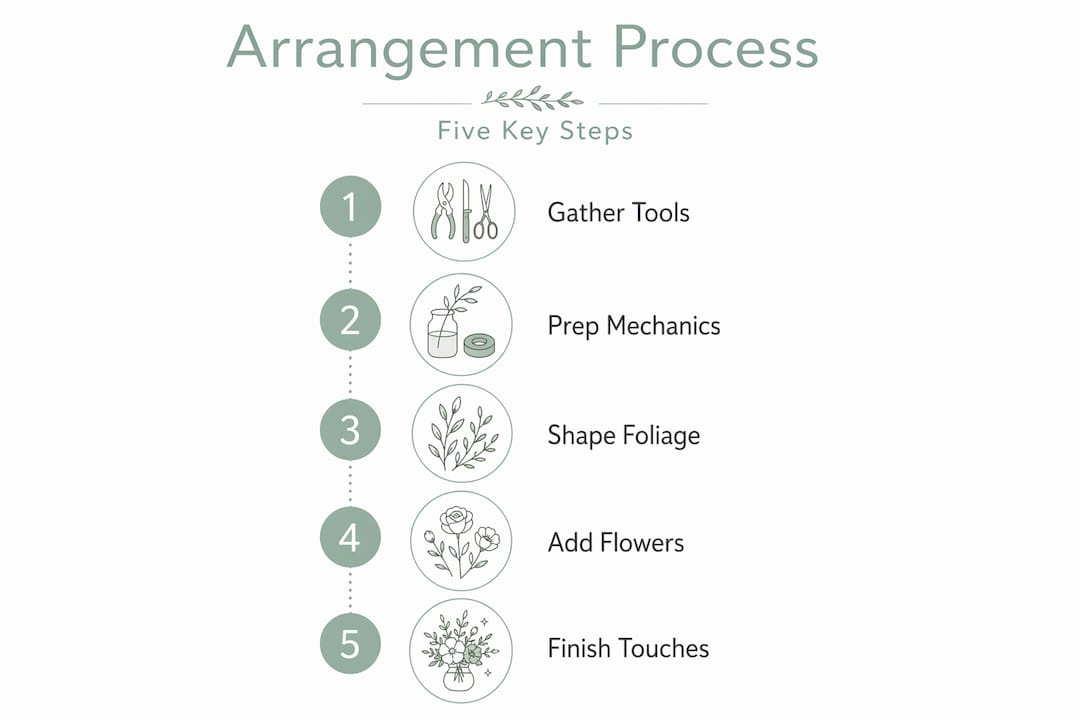
Most people skip straight to the blooms and ignore what happens underneath. This is the single biggest reason home arrangements look amateur. Strong mechanics and structure are the foundation of every stylish arrangement: without them, stems fall where gravity takes them rather than where you intended. A flower frog (a weighted pin holder that sits at the base of your vessel) and/or chicken wire crumpled inside the vase give you real control over every single stem.
| Tool or material | Purpose | Notes |
|---|---|---|
| Flower frog (pin holder) | Anchors stems at precise angles | Best for open-mouthed vessels |
| Chicken wire | Creates a flexible grid inside the vase | Ideal for denser, fuller designs |
| Sharp floral shears | Clean cuts that improve water uptake | Blunt scissors crush stems |
| Watertight vessel | Holds mechanics and water | Ceramic or glass suits most interiors |
| Floral tape | Secures wire and holds mechanics | Invisible when used correctly |
| Floral food sachets | Prolongs freshness and bloom opening | Worth using every time |
Choosing the right vessel is just as important as choosing the right flowers. A heavy-based ceramic vessel in a muted or earthy tone will complement most modern interiors without competing with the arrangement itself. Clear glass works beautifully when the stems are an architectural feature, such as with large tropical leaves or long-stemmed roses. Understanding how bouquet moods and luxury spaces interact helps you make this choice with confidence.
Popular flowers suited to modern, stylish arrangements:
- Peonies — full, voluminous blooms with a naturally luxurious feel
- Dahlias — structured, geometric petals in rich jewel tones
- Ranunculus — layered and delicate, excellent as a secondary flower
- Tulips — architectural stems that move and curve naturally
- Hellebores — moody, painterly, ideal for winter and autumn displays
- Eucalyptus and olive branch — sophisticated greenery that adds depth and scent
Pro Tip: Buy your vessel before your flowers, not after. The vessel dictates scale, colour palette, and the style of mechanics you will use. Working backwards from the container removes a great deal of guesswork.
Preparing your workspace and mechanics: setting the foundation
With materials in hand, the next step is preparing your workspace and mechanics, the real secret to lasting, stylish arrangements.
A well-organised workspace makes the entire process faster and the result more refined. Work at a clean, bright surface at a comfortable height, ideally with a towel underneath to absorb water. Keep your tools within arm’s reach before you begin cutting a single stem. Rushing this preparation stage almost always shows in the final design.
Step-by-step: building your mechanics
- Wash your vessel thoroughly with warm soapy water to remove bacteria that shorten flower life.
- If using a flower frog, secure it to the base with floral putty or waterproof floral tape before filling the vessel with water.
- If using chicken wire, cut a piece roughly twice the diameter of the vessel opening and crumple it loosely before pressing it inside. Leave a small portion above the rim for extra control.
- Fill the vessel two-thirds full with fresh, cool water and add a floral food sachet.
- Before any blooms go in, test your mechanics by gently pressing a thick stem through at the angle you want. The mechanics should hold it firmly without slipping.
- Cover the visible mechanics with the first layer of foliage, such as eucalyptus or ruscus, to create a natural base from which flowers can emerge.
Important: Never skip the mechanics step, even for small or casual arrangements. Strong structural foundations are what allow stems to hold their intended placement throughout the entire lifespan of the arrangement. Skipping this stage is the most common reason luxury-looking designs collapse within 24 hours.
Once your foliage base is in place, the arrangement begins to take on its three-dimensional shape naturally. Foliage covers mechanics, adds texture, and frames the space where your feature flowers will sit. This is a critical stage that makes arrangements stand out far more than adding extra blooms ever could.
Pro Tip: Pre-hydrate your flowers by placing freshly cut stems in deep water for at least two hours before arranging. Trim stems at a 45-degree angle under running water so no air enters the cut. This dramatically extends freshness, particularly for peonies and tulips.
Arranging flowers with professional techniques and modern composition
With the foundation set, the creative part begins. Now let us explore professional techniques that shape truly stylish displays.
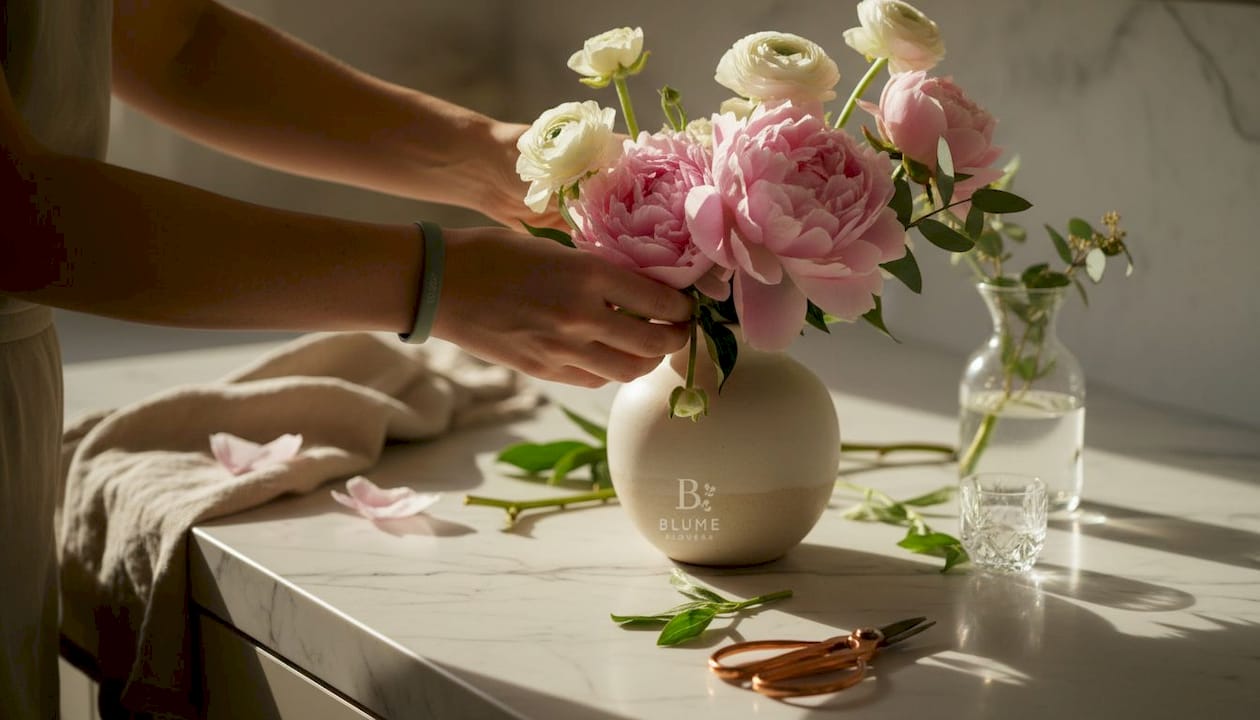
Every professional arrangement is built around a focal flower: one variety or bloom that commands the eye first. This is not necessarily the largest flower, but it is the one with the most visual weight. Think of a single garden rose, a fully open peony, or a dramatic dahlia. Place your focal flower first, slightly off-centre and at varying heights, before building outward.
Step-by-step: layering blooms for professional results
- Place your three to five focal flowers first at different heights and angles. Resist placing them all at the same level.
- Add secondary flowers (ranunculus, tulips, or spray roses) in clusters of two or three to build rhythm throughout the design.
- Use filler flowers such as astilbe, wax flower, or veronica to soften transitions between clusters.
- Step back every few minutes and rotate the vessel to check balance from all angles.
- Add final foliage accents, such as trailing ivy or a single eucalyptus stem, to frame the composition without crowding it.
Understanding the difference between clustering and grouping transforms the visual impact of any arrangement. Modern composition methods such as clustering and grouping control whether flowers read as a unified mass or as distinct individual statements within the design.
| Technique | Effect | Best used for |
|---|---|---|
| Clustering (massing) | Creates a bold, unified block of colour or texture | Dramatic, high-impact centrepieces |
| Grouping (distinct placement) | Each variety stands separately and is individually visible | Artful, painterly, editorial-style displays |
| Mixed approach | Layers of mass with accidental detail | Organic luxury arrangements |
Negative space is one of the most misunderstood tools in floral design. Leaving deliberate gaps in your arrangement, rather than filling every inch, gives the eye somewhere to rest. It frames each bloom and signals confidence in the design. Refer to modern design principles for guidance on how contemporary florists use space as an active design element rather than an oversight.
“Framing and structuring the design space, alongside clustering and grouping, are what separate contemporary professional floral design from simply placing flowers in a vase.”
Taking inspiration from mid-century art for timeless arrangement style
By mastering composition, you are ready to take style even further, infusing your arrangements with timeless mid-century art influences.
Mid-century painters understood something that translates perfectly to floral design: a single, bold focal point surrounded by considered negative space is always more powerful than a busy canvas. Artists of that era favoured strong geometric silhouettes, flat planes of colour, and deliberate tension between form and background. Georgia O’Keeffe’s work is perhaps the most cited example. Her magnified, singular blooms are as much a masterclass in floral composition as they are paintings.
Translating art composition into floral design means thinking about bold colour blocks, structured focality, and sculptural silhouettes before you place a single stem. This approach works equally well whether you are arranging for a luxury dining table or selecting an art-inspired gifting bouquet for someone with an eye for design.
Art-derived principles to apply to your arrangements:
- Colour blocking — use two or three bold colours in distinct zones rather than mixing every shade
- Centralised focal point — place the hero bloom in a commanding position, not lost in the middle of the crowd
- Dynamic negative space — leave deliberate gaps that draw the eye toward what matters most
- Sculptural silhouette — consider the outline of your arrangement as a shape in itself, clean and intentional
- Tonal restraint — resist adding colours just because the flower is beautiful; stay disciplined to your palette
“Great floral design, like great mid-century painting, is about knowing what to leave out as much as what to include. Create something unique and timeless by letting structure do the heavy lifting.”
Pro Tip: Before you begin arranging, spend five minutes with a favourite painting, whether that is a print on your wall or an image on your phone. Identify the dominant colour, the focal point, and how much of the canvas is simply background. Use those proportions as your blueprint. The blüme art collection of reclaimed mid-century style paintings offers a beautiful starting point for this kind of colour and composition reference.
Finishing touches and troubleshooting common arranging mistakes
To perfect your display and ensure it wows guests, finish with expert touches and quick fixes for common errors.
The difference between a good arrangement and a genuinely stunning one is often found in the final five minutes. This is when you step back, rotate the vessel, and make small, considered edits rather than dramatic changes.
Stylish finishing steps:
- Rotate the vessel 360 degrees and check for any bare patches or obvious imbalances
- Remove any leaves that sit below the waterline, as these rot quickly and cloud the water
- Adjust stem heights so no two focal blooms sit at exactly the same level
- Pull out any filler flowers that are obscuring your focal blooms
- Check that foliage is not overwhelming the arrangement; remove any stems that feel crowded
Structural mechanics remain essential even at this finishing stage. If stems are beginning to shift position, a quick adjustment to the chicken wire or the addition of a small floral pin can restore the design instantly.
| Problem | Likely cause | Simple fix |
|---|---|---|
| Stems drooping or falling | Mechanics too loose or absent | Re-cut stems and add chicken wire support |
| Arrangement looks overcrowded | Too many stems of similar height | Remove filler and vary heights dramatically |
| Colours look muddy or dull | Too many varieties mixed randomly | Pull back to three varieties and colour-block |
| Blooms wilting too fast | Dirty water or crushed stems | Change water and re-cut at 45 degrees |
| Arrangement looks flat | All stems placed at same angle | Tilt outer stems outward for a domed effect |
For seasonal arranging tips that reflect current blooms and trends across the West Midlands, it is worth reviewing what is naturally available by month. Seasonal flowers are not only fresher and longer-lasting; they also carry a natural visual harmony that forces a more disciplined, artful palette.
Pro Tip: Less is always more for a high-end result. Remove three stems from any arrangement that feels overcrowded and see whether it immediately looks more intentional and luxurious. Most amateur arrangements suffer from too much rather than too little.
Why true style is about structure, not just blooms: an expert perspective
After working through every step, it is worth pausing to consider what genuinely separates a luxury arrangement from an ordinary one. The honest answer is rarely about the flowers themselves.
We have seen clients spend significant sums on the rarest seasonal stems and produce arrangements that look no better than supermarket bunches. We have also seen simple garden flowers, placed with clear mechanics and thoughtful composition, stop guests in their tracks at corporate events across Birmingham and Solihull. The variable in every case is not budget. It is structure.
The mechanics underneath your arrangement are the equivalent of tailoring in a luxury garment. Nobody sees the internal construction, but everyone feels its presence. When stems are exactly where they are meant to be, the eye reads confidence and intention. When they have slipped or crowded, the eye registers chaos, however beautiful the individual blooms might be.
Art, particularly mid-century painting, teaches a lesson that most people never apply to floristry: restraint is a form of confidence. Knowing what to leave out is a more sophisticated skill than knowing what to put in. The most memorable arrangements we see, and create, always have breathing room. They use floral craftsmanship for luxury in the truest sense, combining reliable mechanics with genuine design thinking.
The good news is that these are learnable skills. With the right tools, a clear starting process, and an art-informed eye for composition, anyone can produce arrangements that look genuinely professional. The flowers almost become secondary once the structure and composition are right.
Elevate your space with professional arrangements from Blüme Flowers
If you love the artful principles in this guide but want the stunning results without the time investment, BLÜME by Urban Design Flowers creates exactly this kind of work every day. Our Birmingham-based studio designs luxury arrangements for private clients, special occasions, and corporate spaces across the West Midlands, with all the structural craft and compositional thought described above built into every order.
For a beautifully structured centrepiece delivered to your door, explore our peony bouquet, one of our most sought-after luxury designs. Businesses and event hosts in Birmingham and Solihull looking for regular statement flowers, reception displays, or event floristry can discover our tailored corporate flower services. Let us handle the mechanics and composition so you can simply enjoy the result.
Frequently asked questions
What mechanics are essential for stylish flower arranging?
A flower frog or chicken wire provides the stability that allows stems to hold their intended placement. Strong structural mechanics are the first and most critical step in any professional-standard arrangement.
How do I pick flowers for a modern, stylish look?
Choose one strong focal flower and build around it using bold colour blocks or sculptural forms. Art-inspired composition thinking such as structured focality and tonal restraint is the fastest route to a contemporary result.
I want my arrangements to last — how can I prevent drooping or wilting?
Use clean shears, pre-hydrate your flowers for at least two hours before arranging, and ensure every stem is firmly supported by your mechanics. Changing the water every two days and removing any submerged leaves also extends the life of your arrangement considerably.
How do professional florists use negative space for style?
They deliberately frame the design using space and groupings, allowing each bloom to be seen as an individual rather than disappearing into a dense mass. Framing and structuring the design space is one of the clearest markers of professional-level floral composition.