


Step-by-step guide to perfect luxury flower arrangements
TL;DR:
- The difference between a beautiful floral arrangement and a forgettable one lies in method, mechanics, and intentional design.
- Proper preparation, tool selection, and understanding of floral mechanics ensure arrangements are both stable and visually impactful.
- A truly luxurious arrangement reflects purpose, context, and emotional intention beyond just technical skill.
You’ve spent real money on beautiful blooms, arranged them carefully, and yet something still feels off. The result looks pleasant enough but not quite the polished, magazine-worthy display you envisioned. The difference between a gorgeous arrangement and a forgettable one rarely comes down to the flowers themselves. It comes down to method. This guide walks you through every stage of building a luxury-worthy floral arrangement, from choosing the right materials and mechanics to perfecting the final touches for Birmingham events, corporate spaces, and special gifting occasions.
Table of Contents
- What you need to start your luxury flower arrangement
- Step by step: Building a stable flower arrangement
- Event and occasion tips: Arrangements for impact and longevity
- Troubleshooting and perfecting your arrangement
- Why true luxury arrangements are a mindset, not just a method
- Elevate your next occasion with bespoke floral design
- Frequently asked questions
Key Takeaways
| Point | Details |
|---|---|
| Essential tools matter | Quality support mechanics and preparation set the foundation for standout arrangements. |
| Follow a clear sequence | Placing greenery first, then focal flowers, then accents ensures balance and elegance. |
| Context transforms impact | Tailoring arrangements to their setting and purpose creates lasting impressions. |
| Support ensures stability | Proper mechanics like tape grids or frogs prevent drooping and keep stems secure. |
| Finishing details count | Attention to proportion, restraint, and the event context elevates your design from pretty to luxurious. |
What you need to start your luxury flower arrangement
Before you make a single cut, gathering the right materials is essential. Many home arrangements fall apart not because of poor taste but because of missing or incorrect tools. Think of it the same way a chef approaches a dish: the quality of the ingredients and the sharpness of the knife matter just as much as the recipe itself.
Here is what you will need before you begin:
- Fresh flowers: A mix of focal blooms (such as roses, peonies, or lilies), filler flowers (wax flower, gypsophila), and greenery (eucalyptus, ruscus, or salal)
- Floral snips or sharp scissors: Clean cuts prevent bacterial build-up in the water
- Floral preservative: Dissolved in water, this extends stem life considerably
- A suitable container or vase: Heavy-based vessels prevent tipping; the shape of the mouth dictates how much support you will need
- Stem mechanics: A floral frog, tape grid, or floral foam to hold stems in place
- Clean water: Lukewarm is ideal for most blooms as it encourages uptake
Choosing the right stem mechanics
The difference between an arrangement that holds its shape overnight and one that slumps by mid-afternoon almost always traces back to the mechanics used. Understanding your options lets you match the right tool to the right occasion.
| Mechanic | Best for | Difficulty | Durability |
|---|---|---|---|
| Tape grid | Low, wide vases; informal occasions | Beginner | Medium |
| Floral frog (kenzan) | Structured, minimalist, or ikebana-inspired styles | Intermediate | High |
| Floral foam | Large event arrangements; complex designs | Intermediate | Medium to high |
Floral craftsmanship basics explain how each of these mechanics works in context, and which suits the occasion you are planning for. For corporate events or entrance displays, a floral frog or sturdy foam block tends to produce the most reliable results. For a home table centrepiece, a simple tape grid is quick and effective.
As part of modern design essentials, the choice of container matters more than most people realise. A vessel that is too tall relative to the arrangement’s width makes it appear unbalanced. A rule of thumb: the arrangement should be approximately one and a half to two times the height of the vase.
Pro Tip: If you are using floral foam, never push it under the water to soak it. Place it on the surface and allow it to sink on its own. Forcing it down traps air pockets inside, which blocks water from reaching your stems and causes premature wilting.
Step by step: Building a stable flower arrangement
With all the materials gathered, you’re ready for the core assembly. Here’s how to bring them together step by step for a flawless structure that holds up through events, celebrations, and long gifting journeys.
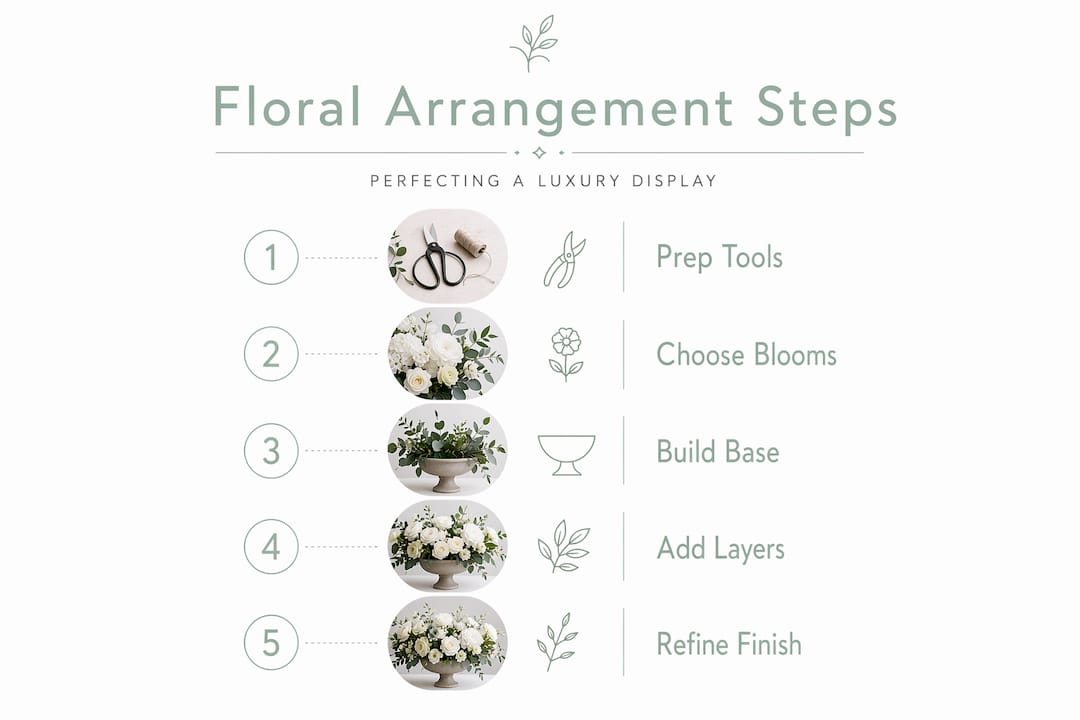
- Recut all stems at a 45-degree angle. Do this under running water or in a bowl to prevent air from entering the stem. Longer stems provide more flexibility when positioning.
- Prepare your water. Fill the container approximately two thirds full with lukewarm water and dissolve the floral preservative according to the packet instructions.
- Set up your mechanics. Secure your tape grid, position your frog, or trim your foam to fit snugly within the container. The foam should sit slightly above the rim so that stems can be inserted at angles.
- Add your greenery first. Place foliage around the perimeter and through the centre of the grid or foam. Greenery establishes the shape and scale of the arrangement before a single flower goes in.
- Position your focal flowers. These are your statement blooms, the ones the eye travels to first. Place them at staggered heights and varying angles rather than in a flat line. Odd numbers (three or five focal blooms) tend to look more natural than even groupings.
- Layer filler and accent flowers. Wax flower, gypsophila, or small spray roses fill visual gaps and soften hard edges. Think of them as the supporting cast that makes the focal blooms appear more dramatic.
- Inspect from all angles. Step back, turn the arrangement, and look from the side and from above. Guest-ready arrangements look considered from every viewpoint, not just the front.
Key design principles to keep in mind
A strong arrangement reflects several foundational floral design principles working together. Balance refers to visual weight being distributed evenly across the arrangement, whether symmetrically or asymmetrically. Proportion ensures your blooms relate sensibly to the scale of the container and the space it occupies. Rhythm is created when repeating colours, textures, or stem lines draw the eye through the piece naturally. Colour harmony ties everything together, whether you are working with a monochromatic palette of blush and cream or a contrasting bold statement in deep burgundy and white.
Pro Tip: Once a stem is placed into foam or a tape grid, avoid repositioning it repeatedly. Every movement creates a larger hole in the foam, loosening stem stability and allowing stems to shift or droop later. Make deliberate placements the first time.
Event and occasion tips: Arrangements for impact and longevity
After building your core arrangement, the next challenge is tailoring it for the environment where it will be displayed. A boardroom, a birthday party at home, and a wedding reception all call for different approaches, even when the flowers are similar.
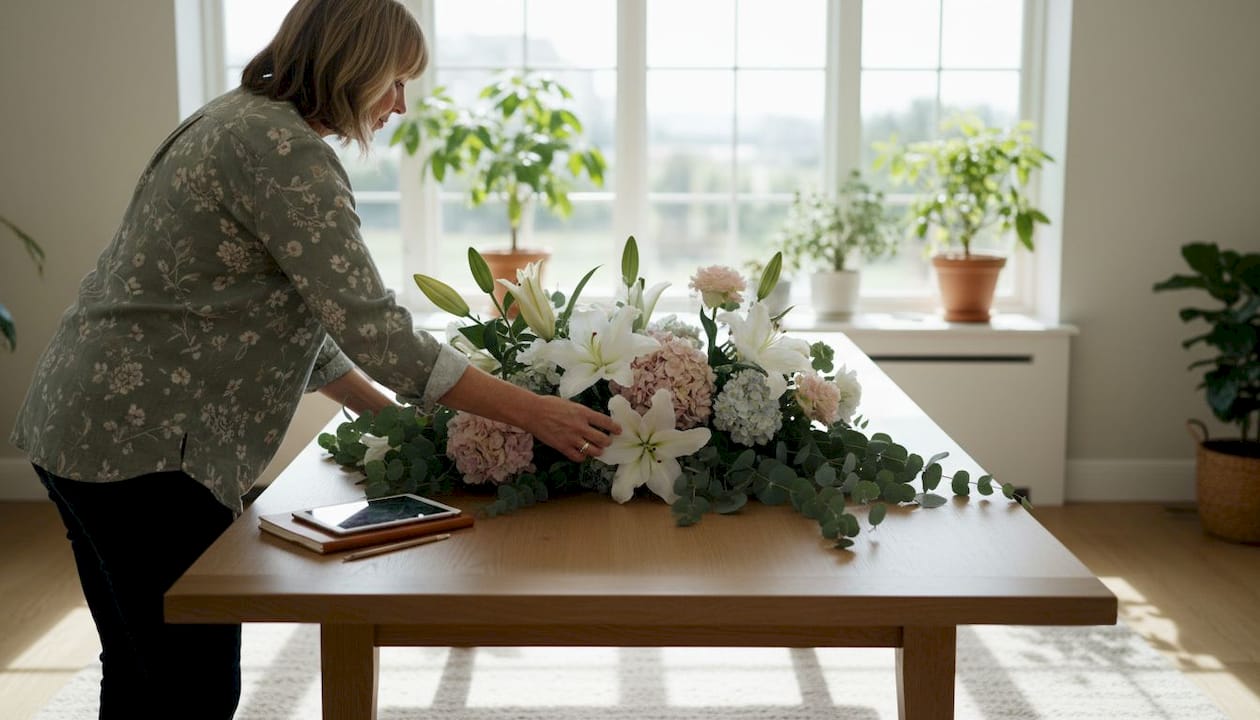
Entrance impact is one of the most important considerations for event floristry. The first arrangement a guest encounters sets the tone for everything that follows. Position a statement piece at the arrival point, at eye level or just slightly above, so it catches attention immediately without requiring guests to look up or down.
Sightlines matter enormously at seated events. An arrangement that towers above the heads of seated guests is ideal for buffet tables or registration desks, but a dining table centrepiece should sit below eye level so guests can converse across it comfortably. A useful guideline: keep dining arrangements under 30cm in height or over 60cm so they either tuck neatly below sightlines or arch dramatically above them without interrupting conversation.
For photography, position flowers so they frame a scene rather than dominate it. Consider wedding styling inspiration as a reference for how florals interact with the broader visual setting when photography is central to the occasion.
Corporate arrangement inspiration shows how professionals approach brand-aligned floristry for offices and events. Varied heights are used in the vast majority of professional event arrangements to create visual definition and prevent displays from appearing flat. Mapping arrangements to key arrival points and transitional spaces, such as lifts, reception counters, and meeting room entrances, ensures flowers are encountered at precisely the moments they create most impact.
Here are the top tips for making event arrangements last throughout a long occasion:
- Use fresh cuts before the event day. Recut stems the morning of the event so they are drawing water actively when guests arrive
- Choose foliage wisely. Hardy greens such as eucalyptus and ruscus hold up well in warm rooms and under bright lighting
- Maintain water levels. For multi-hour events, check containers at the halfway point and top up with cool water
- Avoid direct sunlight and heat sources. Position arrangements away from windows, spotlights, and radiators wherever possible
- Condition flowers in advance. Place blooms in water overnight before the event to allow them to fully hydrate and open to their intended shape
Choosing seasonal flowers for your event not only reduces cost but also ensures you are working with the most robust, freshest blooms available. A well-chosen seasonal arrangement can outlast an out-of-season alternative by several days, which matters enormously when you need flowers to perform through a full working day, wedding, or corporate reception.
Troubleshooting and perfecting your arrangement
Even the best-planned arrangements need a finishing touch or a quick fix. Knowing how to identify and correct common problems turns a good attempt into a truly polished result.
The most frequent issues are:
- Mechanics not properly secured. A tape grid that lifts away from the rim, or a frog that shifts, will allow stems to lean and fall. Secure tape firmly to a dry vase rim before adding water.
- Stems repositioned too often. As noted earlier, every unnecessary movement loosens your grid or foam. This single habit accounts for a significant proportion of drooping arrangements.
- Wrong container for the style. A tall arrangement in a shallow bowl will be structurally unstable. Match container depth and width to your intended design before you begin.
- Stale or unchlorinated water. Water that is not treated with preservative becomes a breeding ground for bacteria within 24 hours, which clogs stem ends and causes rapid wilting.
Here is a quick-fix checklist when something looks or feels wrong:
- Drooping stems: Remove, recut at a fresh angle, and reinsert or place in a bucket of deep water for an hour before returning to the arrangement
- Arrangement leaning: Add weight to the base side using heavier foliage stems or reposition to a more stable container
- Gaps appearing: Use secondary filler foliage to bridge spaces without overpowering focal blooms
- Container looking untidy: Wipe the outside of the vase, remove any fallen petals or leaves from the water, and ensure the container itself is presentable
“Without stem support, bouquets can collapse, tilt or slump. The mechanics you choose are the invisible foundation that makes every beautiful arrangement possible.”
For a full review of what makes displays truly polished, the elegant arrangements guide covers the finishing details that separate a professional-quality piece from a well-intentioned attempt. Small things, such as wiping stems before placing them, twisting rather than forcing them into foam, and refreshing filler foliage on long event days, add up to a noticeably more sophisticated result.
Why true luxury arrangements are a mindset, not just a method
Having covered the technical and visual aspects, it is worth stepping back to consider what truly distinguishes a memorable, luxury arrangement from the merely decorative.
The honest answer is that method alone does not get you there. A checklist of steps, followed correctly, produces a competent arrangement. What produces an exceptional one is the intention behind every decision. Where will this arrangement be seen? Who will encounter it first, and in what emotional state? Is this a moment of celebration, comfort, or professional impression-making? These questions should be asked before the first stem is cut.
At BLÜME, we see this difference constantly. The arrangements that receive the most genuine response are never the ones with the most flowers or the most expensive blooms. They are the ones where restraint was exercised deliberately, where empty space was used as a design element rather than filled anxiously, and where the colours and textures were chosen with a specific place and person in mind.
Many home arrangements fall short not because of poor technique but because they stop at ‘pretty’ rather than reaching for ‘purposeful.’ A bouquet created for a Birmingham boardroom should communicate a different story to one arranged for a birthday centrepiece in a domestic dining room, even if both use roses and eucalyptus.
The discipline of choosing designer bouquets for prestige occasions is not simply about spending more. It is about understanding that every element, the mechanics, the vessel, the empty space, and the context, carries communicative weight. Practising intentional choices and pausing before adding the next stem is the single habit that accelerates improvement faster than any technique alone.
Elevate your next occasion with bespoke floral design
If this guide has inspired you to push your next event or gifting moment to a genuinely professional standard, but you would rather leave the craft to specialists, we are here for exactly that.
At BLÜME by Urban Design Flowers, we create bespoke, event-ready arrangements for personal celebrations, corporate occasions, and gifting across Birmingham, Solihull, and the surrounding region. From beautifully structured peony bouquets to full-scale corporate floral service packages, every arrangement is crafted with the precision, intentionality, and seasonal awareness this guide has described. Whether you need same-day luxury delivery or a planned partnership for regular office or event floristry, our team brings professional results without any of the effort on your part.
Frequently asked questions
What are the best flowers to use for long-lasting event arrangements?
Choose resilient blooms such as lilies, carnations, and orchids alongside hardy foliage, as event arrangements that travel and perform under event conditions demand flowers with strong cell structure and water retention.
How do I stop stems from drooping in my arrangement?
Secure stems using a tape grid or floral frog and avoid moving them once placed. Proper stem mechanics are the single most important factor in preventing droop.
Can I reuse floral foam for multiple arrangements?
No. Floral foam should be used once per arrangement only. Reused foam is structurally compromised and poses hygiene risks that shorten flower life considerably.
What makes an arrangement suitable for a corporate office?
Corporate designs should focus on impact at arrival points, use varied heights for visual definition, and reflect the brand’s tone. Corporate event floristry maps arrangements to the event flow to maximise impression at every key moment.