


Thoughtful floral curation made simple: an essential guide
TL;DR:
- Thoughtful floral curation involves deliberate selection to support a specific theme, mood, and function. It starts with defining the core feeling and then uses design elements like form, line, color, texture, and space to create intentional arrangements.
Thoughtful floral curation is the deliberate selection and placement of botanical materials to support a cohesive theme, mood and function rather than simply filling a vase with whatever is available. Before you choose a single stem, decide one thing first: the core feeling you want the arrangement to create. Joyful and abundant? Calm and architectural? That single decision filters every choice that follows, from palette to proportion to the container itself.
Three anchors make this process concrete. BLÜME by Urban Design Flowers uses the five elements of floral design (form, line, colour, texture and space) as a working framework for every commission. Alongside those elements, the Good-Better-Best proposal structure helps clients allocate budget across impact moments without guesswork. Start there, and explaining thoughtful floral curation to yourself or a florist becomes straightforward.
- Decide the feeling first. Write one sentence: “This arrangement should feel ___.” Pin it to your brief before anything else.
- Identify your top two impact moments (the ceremony arch, the welcome table, the gift table) and allocate most of your budget there.
- Use the five elements as a checklist when reviewing any arrangement: form, line, colour, texture, space.
Table of Contents
- How does curated floral design differ from a basic arrangement?
- What are the core elements and principles of floral design?
- How do colour choices shape mood and visual movement?
- Why does seasonality matter for curated floral work?
- Where should you concentrate floral impact across an event?
- What is the step-by-step process for curating an arrangement?
- How does BLÜME translate a brief into a curated result?
- How do you describe a floral design to a florist?
- Floral curation in practice: event and personal project examples
- What are the most common pitfalls in floral curation?
- Key takeaways
- Why curation is worth the investment
- Commission a curated arrangement from BLÜME
- Useful sources and further reading
How does curated floral design differ from a basic arrangement?
Curation is intentional storytelling with stems. A basic arrangement fills a space with colour; a curated design uses every stem to create movement, weight or spatial definition, and each element has a specific purpose.
The practical difference shows up in editing decisions. A basic arrangement adds stems until it looks full. A curated design removes stems until only the purposeful ones remain. That restraint is what separates commodity bunching from considered, luxury work.
Curation earns its investment most clearly in three contexts: events where the florals set the atmosphere for a hundred guests, meaningful gifts where the recipient should feel the thought behind the stems, and corporate settings where flowers signal brand values and care. For a quick midweek pick-me-up, a simple seasonal bunch is perfectly sufficient.
Pro Tip: Step back from any arrangement, photograph it on your phone, and look at the image rather than the piece itself. Flattening it into a single frame reveals balance issues, rhythm gaps and overcrowding that are invisible when you are working close up.
What are the core elements and principles of floral design?
The five elements are the working language of curation. Design elements are interconnected: adjusting one changes how all the others read.
- Form — the three-dimensional shape of individual blooms and the overall silhouette of the arrangement. Round forms (roses, peonies) feel full and classic; linear forms (gladioli, delphiniums) feel architectural.
- Line — the visual path the eye travels through the piece. Strong diagonal lines create energy; horizontal lines feel restful.
- Colour — the element that creates first impressions and controls mood. Covered in depth in the next section.
- Texture — the surface quality of petals, foliage and stems. Mixing smooth (tulips) with rough (thistles) or feathery (astilbe) adds depth without adding bulk.
- Space — the negative space around stems. Leaving deliberate gaps prevents visual noise and lets focal blooms breathe.
The guiding principles that govern how those elements interact include balance (symmetrical or asymmetrical), proportion and scale, rhythm, emphasis and unity. Proportion is where most amateur arrangements go wrong.
| Proportion rule | Guidance |
|---|---|
| Arrangement height | Approximately twice the height of the container |
| Container height | Roughly one-third of the total height or mass |
| Rule of three (grouping) | Odd numbers of stems (3, 5) read as more natural than even groupings |
| Focal to filler ratio | One focal bloom supported by two to three filler or texture stems |
How do colour choices shape mood and visual movement?
Colour controls first impressions and must support form and line rather than replace them. Get the structure wrong and no palette will save it.
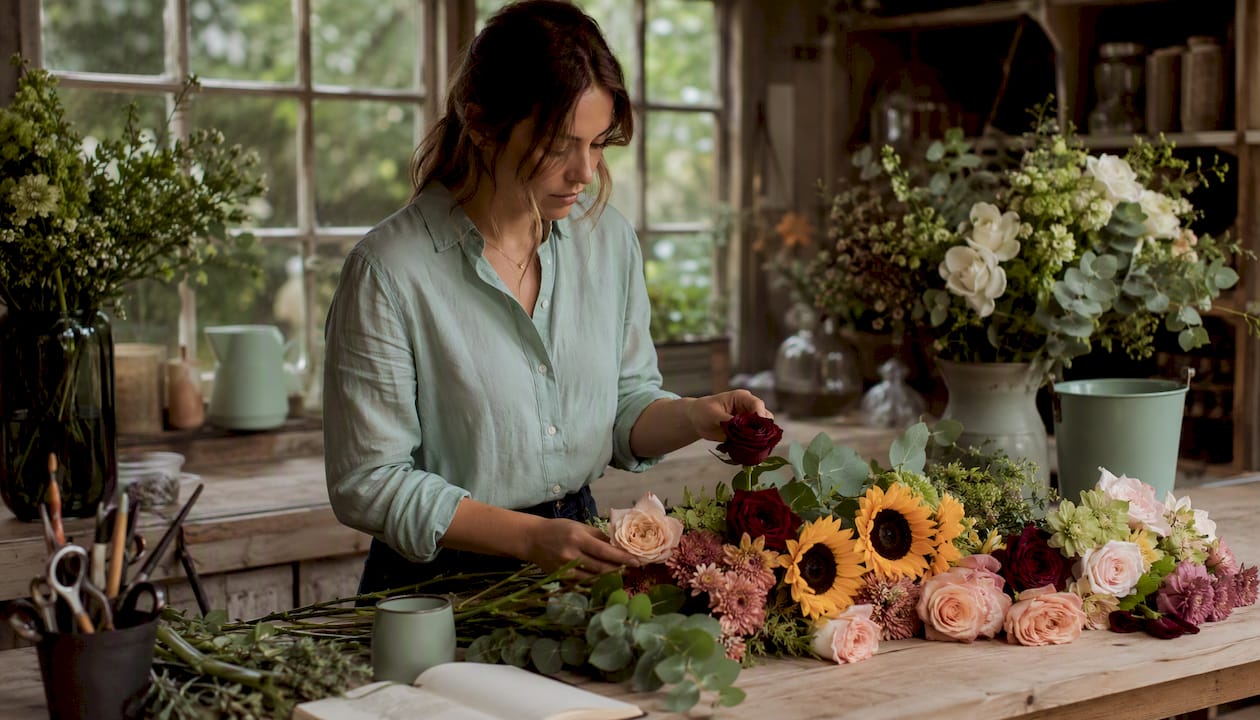
Warm colours (red, orange, yellow) advance and draw the eye forward; cool colours (green, blue, violet) recede and create calm. Use that relationship deliberately: a warm focal bloom placed at the centre of an arrangement pulls the eye in; cool foliage at the edges pushes the composition back and creates depth.
Three palette approaches cover most situations:
Tonal or monochrome — varying shades of a single hue (blush through deep burgundy, for example). Feels sophisticated and restful. Works well for sympathy pieces, corporate receptions and minimalist interiors where the arrangement should complement rather than compete.
Analogous soft harmony — two or three adjacent colours on the colour wheel (peach, coral, soft yellow). Feels warm and cohesive without the tension of contrast. A reliable choice for weddings, birthday gifts and spring events where the mood should feel welcoming.
High-contrast focal pop — one vivid accent colour against a neutral or tonal base (a single deep plum stem in an arrangement of ivory and sage). The contrast creates a clear focal point and stops the eye. Useful for entrance installations or table centres where you need impact from a distance.
Pro Tip: Before committing to a palette, gather physical swatches or printed colour references and photograph them together in the same light as the event space. Screen colours and real petal colours diverge significantly, and a palette that looks cohesive on a mood board can clash under warm tungsten lighting.
Why does seasonality matter for curated floral work?
Seasonal stems look better, last longer and usually cost less. Provenance and seasonality are not ethical add-ons to thoughtful curation; they are part of what makes a design coherent and honest.
UK seasonal stem examples:
- Spring (March to May): tulips, ranunculus, sweet peas, narcissi, hyacinths, cherry blossom
- Summer (June to August): dahlias, sweet Williams, cornflowers, peonies, lavender, sunflowers
- Autumn (September to November): chrysanthemums, nerines, rosehips, hypericum berries, amaranthus
- Winter (December to February): hellebores, amaryllis, eucalyptus, waxflower, dried pampas
When sourcing, ask your florist or supplier three questions: Where were these grown? How were they transported? Are any stems certified (Fairtrade or equivalent)? Local growers reduce air miles and typically deliver fresher stems with longer vase life.
Sustainability in practice means choosing reusable vessels over single-use foam, planning stem reuse across event zones (ceremony to reception, for example), and composting spent material rather than binning it. Small decisions, but they add up across a full event commission.
Where should you concentrate floral impact across an event?
Prioritise focal moments first, then secondary coverage. Spreading a limited budget evenly across every surface produces mediocre results everywhere. Concentrating it on two or three key positions creates moments guests remember.
Impact moment priority checklist:
- Ceremony arch or registrar’s table (highest visual dwell time)
- Welcome or entrance table (first impression on arrival)
- Top table or head table centrepiece (photographed most)
- Gift or card table (secondary focal point, lower investment)
- Guest table coverage (volume, not detail)
The Good-Better-Best tiered approach maps directly onto this hierarchy: the Best tier concentrates on the top two focal moments with full installations; the Better tier covers those plus the top table; the Good tier delivers one strong focal moment and simple guest table coverage.
| Position | Visual role | Budget allocation |
|---|---|---|
| Entry focal (welcome table or arch) | First impression; sets the design language | High — a substantial share of the total |
| Ceremony focal (arch, registrar’s table) | Anchor moment; most photographed | High — a substantial share of the total |
| Table coverage (guest tables) | Atmosphere and cohesion | Lower — a smaller share of the total |
For a small vignette (a home display or gift table), the same logic applies at a smaller scale: one strong focal bloom, supporting texture, deliberate negative space. Proportion rules hold regardless of size.
What is the step-by-step process for curating an arrangement?
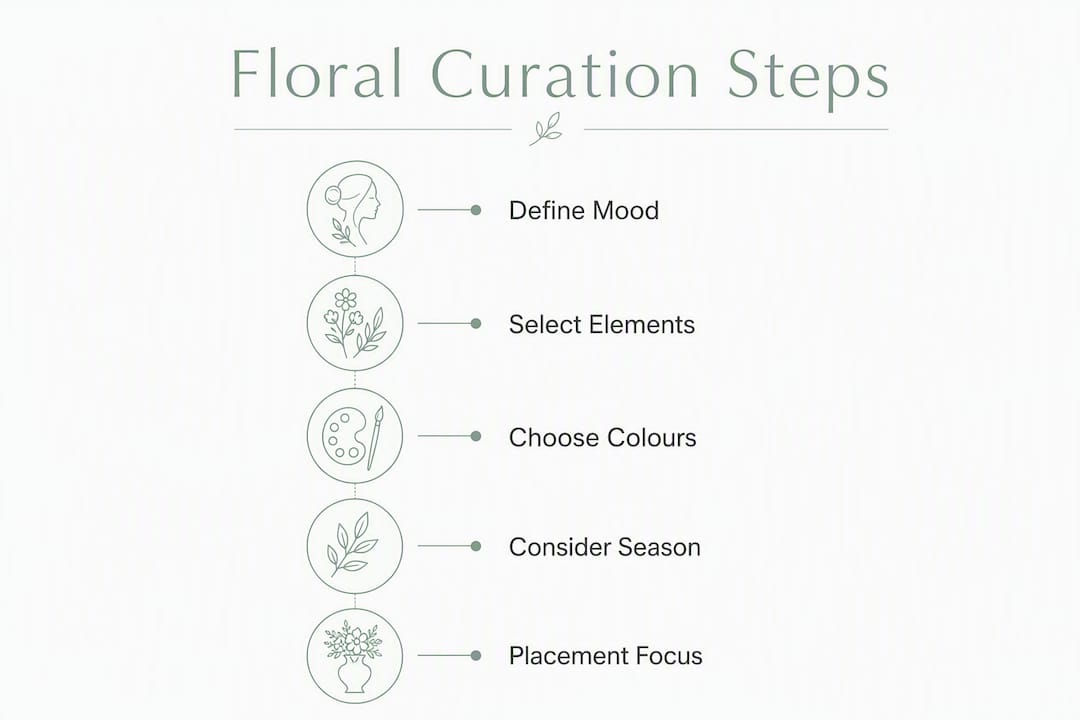
Follow five steps: define the feeling, map impact moments, select palette and stems, build the mechanics, then refine and care.
- Define the feeling. Write one sentence describing the mood. This filters every decision that follows.
- Map impact moments. Identify where the arrangement will live and who will see it, from what distance and for how long.
- Select palette and stems. Choose seasonal material where possible. Apply the proportion table from Section 3: one focal, two to three fillers, deliberate texture contrast.
- Build the mechanics. Condition stems first: clean diagonal cuts, remove submerged leaves, stage in cool water for several hours before arranging. Work from structure (foliage, line stems) to focal blooms to filler.
- Refine and care. Step back, photograph, edit. Remove before you add. Change water every two days, recut stems, keep away from direct heat and fruit.
Florist briefing checklist:
- Core feeling (one sentence)
- Scale and placement (dimensions, surface, viewing distance)
- Palette (two to three colours, with any must-avoid shades)
- Must-have stems and any allergies or dislikes
- Budget tier (Good / Better / Best)
- Delivery date, time and placement logistics
How does BLÜME translate a brief into a curated result?
BLÜME by Urban Design Flowers moves from mood to palette to focal moments to a tiered proposal, so clients see exactly what each investment level delivers before committing. Every stem has a specific purpose in a BLÜME commission, whether that is a curated bouquet for a gift or a full event installation across Birmingham and the West Midlands.
A practical commissioning template for BLÜME:
- Feeling: one sentence (“warm, abundant, garden-gathered”)
- Palette: two to three colours plus any must-avoid shades
- Top two impact moments: e.g. welcome table and ceremony arch
- Budget tier: Good / Better / Best
- Must-have stems: e.g. peonies, garden roses
- Must-avoid stems: e.g. lilies (allergy), carnations (personal preference)
- Delivery and placement: date, time, address, access notes
Presenting a photographic, image-led proposal within 24 hours of receiving that brief reduces ambiguity and speeds approval, which is why BLÜME works to tiered visual samples rather than abstract descriptions.
How do you describe a floral design to a florist?
Most clients struggle not with knowing what they want but with finding the words. A short vocabulary set covers most briefs.
Form words: structured, loose, garden-gathered, architectural, cascading, compact, asymmetric. Mood words: romantic, minimal, dramatic, fresh, wild, restrained, celebratory. Colour words: tonal, monochrome, jewel-toned, pastel, earthy, high-contrast, neutral-led. Scale words: statement, intimate, low-profile, tall and linear, full and domed.
Combine one word from each group and you have a working brief sentence: “A loose, romantic, pastel arrangement, low-profile and full.” That single sentence tells a florist the silhouette, the mood, the palette direction and the scale. Add your must-have stems and budget tier and the brief is complete.
A quick self-check before sending any brief: Can you describe the arrangement in one sentence? Have you named the palette and scale? Have you listed any must-avoid stems? If yes to all three, the brief is ready.
Floral curation in practice: event and personal project examples
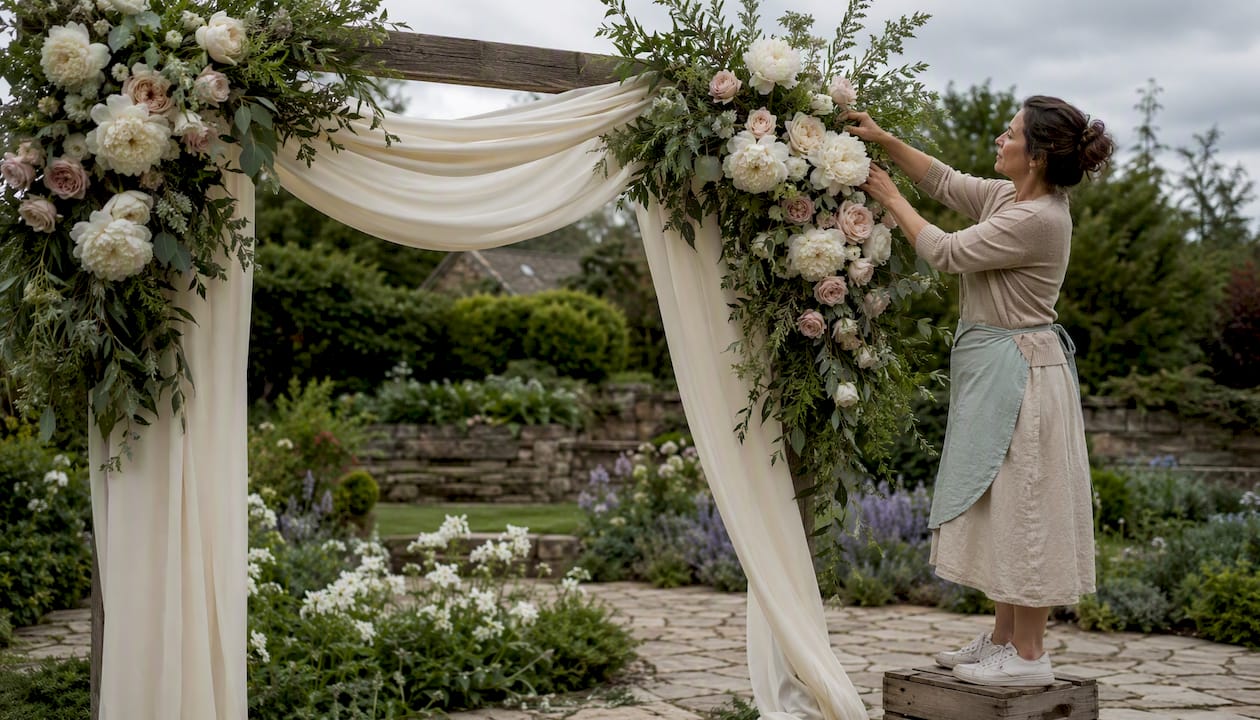
Wedding ceremony arch: The arch is the highest-dwell-time moment in any ceremony. A curated approach concentrates the budget here: a garden-gathered mix of garden roses, sweet peas and trailing jasmine in a tonal blush-to-ivory palette, with deliberate asymmetry so the eye travels across the structure rather than landing on a single point. Guest table posies use offcuts from the same palette, creating unity across the room without duplicating the investment.
Corporate reception desk: Corporate floristry benefits from a restrained, architectural approach. A tall linear arrangement of white amaryllis and eucalyptus in a simple glass cylinder signals quality without visual noise. The cool palette recedes against a warm interior, drawing attention to the desk rather than competing with it.
Birthday gift bouquet: A statement gift bouquet works best when it reflects the recipient rather than the season’s most available stock. A high-contrast focal pop (deep burgundy dahlias against cream and sage) reads as considered and personal. Wrapping and vessel choice extend the curation: a kraft wrap with a single ribbon in the accent colour completes the composition.
Home vignette: A single stem of hellebore in a narrow-necked bottle on a windowsill is a curated decision. The negative space around it, the way the light catches the nodding head, the contrast of the dark stem against pale plaster — all of that is intentional placement, not decoration by default.
What are the most common pitfalls in floral curation?
Overcrowding. Adding stems to fix a problem almost always makes it worse. If an arrangement feels unresolved, remove something before adding anything.
Ignoring scale. A low table centre that reads beautifully at eye level disappears when guests are seated. Always assess an arrangement from the viewing distance and height it will actually be seen from.
Palette drift. Buying stems opportunistically across multiple suppliers often produces a palette that has crept two or three shades away from the original intention. Commit to the palette in writing before purchasing.
Skipping conditioning. Unconditioned stems wilt within hours of arrangement, particularly in warm event venues. The City & Guilds floristry curriculum treats conditioning as foundational, not optional: clean diagonal cuts, submerged leaf removal and cool-water staging before any arrangement begins.
Mismatched container and arrangement. A heavy, ornate vase competes with delicate stems; a plain cylinder disappears beneath a full, abundant arrangement. The container is part of the composition, not just a vessel.
Key takeaways
Thoughtful floral curation requires defining a feeling first, then applying the five design elements (form, line, colour, texture, space) to every stem decision, from focal moments to filler.
| Point | Details |
|---|---|
| Define feeling before stems | Write one sentence describing the mood before selecting any botanical material. |
| Prioritise impact moments | Allocate the majority of the budget to the top two focal positions; spread the remainder across secondary coverage. |
| Trust seasonality | UK-seasonal stems look better, last longer and typically cost less than imported out-of-season alternatives. |
| Edit ruthlessly | Photograph the arrangement and remove stems before adding; overcrowding is the most common curation error. |
| Blumeflowers curated options | BLÜME by Urban Design Flowers offers tiered proposals and curated bouquets for events, gifts and corporate commissions across Birmingham, the West Midlands and nationwide. |
Why curation is worth the investment
Most people underestimate how much a curated arrangement changes the way a space feels, not just looks. There is a difference between a room that has flowers in it and a room where the flowers belong. That difference is entirely down to intention.
The conventional wisdom is that more flowers equal more impact. The opposite is usually true. A single well-placed focal arrangement at an entrance does more for a guest’s first impression than six mediocre table posies combined. Curation is a discipline of subtraction as much as selection, and that is the part clients rarely expect.
What curated work also does, quietly, is save money over time. Fewer stems used purposefully outperform more stems used carelessly. Waste drops. The brief gets tighter. The result gets cleaner. Clients who commission curated work once tend to find it difficult to go back to ordering by the bunch, because they have seen what intention actually looks like in a vase. Bouquets genuinely shape the mood of a space, and once you have experienced that, a generic arrangement feels like a missed opportunity.
Commission a curated arrangement from BLÜME
If you would rather hand the brief to a specialist than work through it yourself, BLÜME by Urban Design Flowers offers exactly that. The difference from ordering a standard bouquet is a tiered proposal process: you share your feeling, palette and top two impact moments, and BLÜME returns Good, Better and Best options with visual references so you can see what each investment level delivers before committing.
For events, corporate commissions and meaningful gifts across Birmingham, Solihull, the West Midlands and nationwide, the process is straightforward. Browse the Beautifully Simple Peony Bouquet as a starting point for curated retail, or visit the corporate flowers page to enquire about a bespoke event commission. Include your feeling sentence, palette, budget tier and delivery date, and BLÜME will handle the rest.
Useful sources and further reading
- Floral design (Wikipedia) — overview of the five elements and seven principles with historical context.
- City & Guilds Level 3 Advanced Technical Diploma in Floristry — the UK’s recognised professional floristry qualification framework, covering design principles and plant care.
- Seasonal flower arrangements: style, luxury and sustainability (Blumeflowers) — UK-focused guidance on choosing seasonal stems and sustainable sourcing.
- Examples of modern floral styling: 2026 inspiration guide (Blumeflowers) — image-led reference for current palette and form trends.
- Floral proposals: how to present options without overwhelming clients (Curate) — explains the Good-Better-Best tiered proposal framework for event commissions.
- Top luxury scent picks: accessible options for every budget (ThePerfumeSampler) — useful companion reading on sensory pairing when planning scent-aware floral atmospheres for events.