


Examples of modern floral styling: 2026 inspiration guide
TL;DR:
- Modern floral styling emphasizes sculptural, architectural arrangements that focus on height, movement, and negative space. It relies on minimalism, tonal color schemes, and deliberate editing to create stylish and sophisticated designs.
Modern floral styling is defined by sculptural, architectural arrangements that prioritise height variation, organic movement, and negative space over the traditional dense, rounded bouquet. The industry term for this discipline is contemporary floral design, though “modern floral styling” captures the aesthetic shift that has reshaped weddings, corporate events, and home interiors alike. The best examples of modern floral styling share three qualities: intentional restraint, tonal cohesion, and a clear relationship between the flowers and the space around them. This guide covers the most compelling approaches, from mono-floral minimalism to ikebana-inspired compositions, so you can apply these ideas with confidence.
1. Sculptural and architectural floral arrangements
Sculptural floral design arranges flowers so they interact with architectural space, embracing height and negative space rather than filling surfaces. This is the defining shift in modern event floral styling. Instead of a dense dome of blooms, the arrangement becomes a three-dimensional structure that breathes.
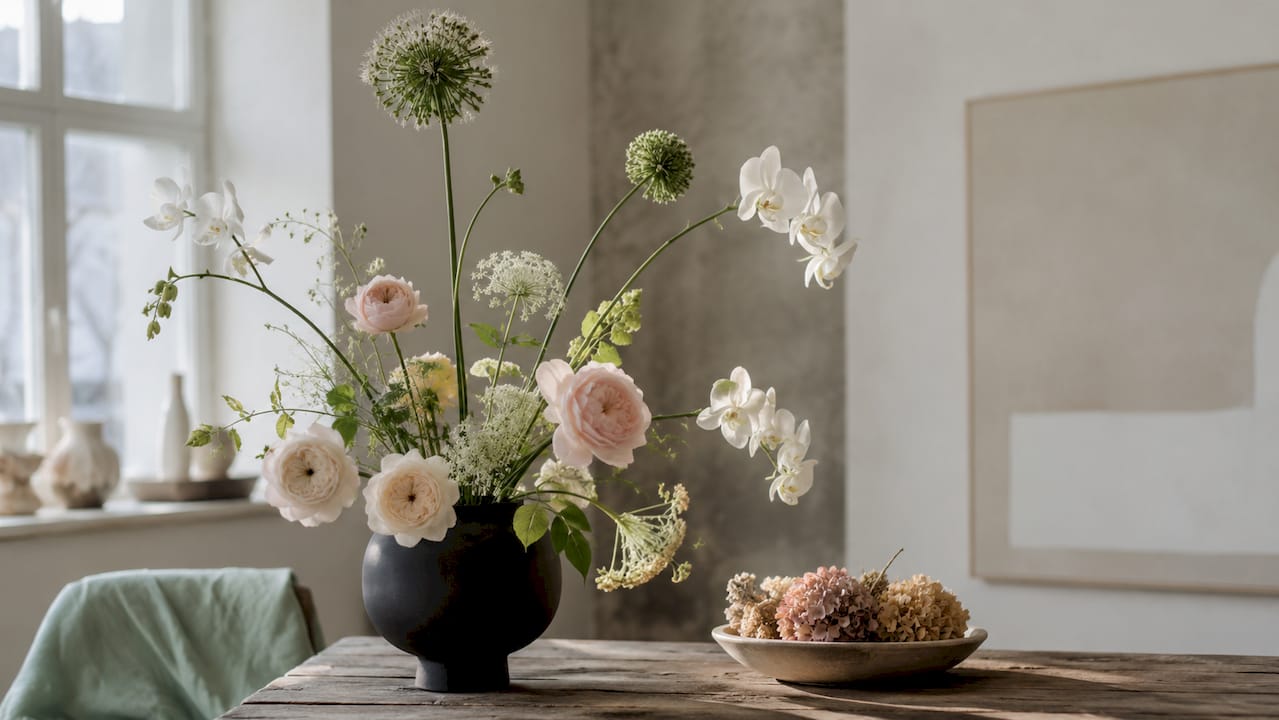
Long-stemmed flowers are the primary tool here. Alliums, with their globe-shaped heads on tall, bare stems, create instant vertical drama. Orchid sprays introduce cascading lines that echo the curves of a venue ceiling or a window arch. Layering these at varied heights produces the architectural form that distinguishes contemporary work from traditional floristry.
Event and wedding designers increasingly mirror the geometry of their venue. A reception in a Georgian townhouse might feature arrangements with clean vertical lines and restrained foliage, echoing the room’s symmetry. A modern industrial space calls for asymmetric, branching structures that reference exposed steel beams.
- Use alliums, orchids, and sculptural branches as primary stems
- Vary heights deliberately, not randomly
- Limit foliage to what earns its place structurally
- Step back after each addition to assess negative space
Pro Tip: Edit before you add. The most common mistake in sculptural arranging is filling gaps that were meant to be empty. Negative space is not absence. It is the pause that makes the eye move.
2. Mono-floral minimalism: one variety, maximum impact
Mono-floral minimalism uses a single flower variety in disciplined, uniform arrangements to create luxury impact. The technique demands more precision than mixed bouquets, not less. Every stem must earn its position.
The most cited example is 60 tulips arranged in a pyramid form, with excess foliage stripped and stems aligned to a uniform length. The result is a clean, architectural silhouette that reads as both effortless and considered. Luxury clients respond to this approach because it signals confidence. There is nowhere to hide an imperfect stem.
Roses, peonies, and ranunculus all translate well to the mono-floral format. The key is choosing a bloom with enough natural variation in petal texture to hold visual interest across a mass of identical flowers. A single variety of garden rose, for instance, offers subtle tonal shifts from bud to open bloom that prevent the arrangement from feeling flat.
- Strip all excess foliage below the waterline
- Align stem lengths before placing in the vessel
- Choose a bloom with natural tonal variation within the variety
- Use a vessel with a narrow neck to hold stems upright without a grid
Pro Tip: Minimalism in floral design demands discipline and editing. Removing leaves and aligning stems precisely is what makes a single variety visually striking, not simply using fewer flowers.
3. Tonal colour palettes and textural layering
Modern floral styling favours tonal palettes over contrasting colours, using layered shades within a single hue family to add depth with cohesion. This approach dominates 2026 weddings and corporate events. The effect is editorial rather than decorative.
Blush to rose to peach is one of the most popular tonal progressions. Layered blues, greens, and ivory create a cooler, more restrained palette suited to corporate settings. The depth comes not from colour contrast but from textural contrast, which is equally or more important than colour contrast in achieving editorial impact.
A velvety ranunculus placed beside a waxy calla lily beside a feathery astilbe creates visual complexity without introducing a second colour family. This is the principle that separates modern floral design from traditional mixed bouquets, which rely on colour contrast to create interest.
| Approach | Palette | Effect | Best suited to |
|---|---|---|---|
| Tonal layering | Blush, rose, peach | Depth with cohesion | Weddings, luxury gifting |
| Tonal layering | Blue, green, ivory | Calm, editorial | Corporate events |
| Contrasting colours | Red and white | Bold, traditional | Festive occasions |
| Contrasting colours | Purple and yellow | High energy | Informal celebrations |
The table above shows where each approach performs best. Tonal palettes suit occasions where sophistication matters more than visual noise.
4. Editorial luxury tablescapes
Editorial luxury tablescapes use low floral bowls paired with varying-height candles to create vertical movement and cinematic ambience. The Claridge’s London white wedding is the benchmark example. Reflexed roses, calla lilies, ranunculus, and orchids sat low in bowls while taper candles rose above them, creating rhythm across the table.
The logic is counterintuitive. Keeping flowers low does not reduce impact. It concentrates the eye at table level while the candles carry the vertical line upward. Guests can see across the table, which improves conversation, and the overall effect feels considered rather than crowded.
This format works equally well for corporate dinners and private celebrations. The key is choosing flowers with enough surface texture to read at close range. Reflexed roses, where the petals are individually folded back to reveal the inner bloom, are particularly effective because they reward close inspection.
Layering floral materials by weight anchors heavier elements low and lets lighter accents float upward to reveal movement. Applied to a tablescape, this means placing heavier blooms like roses and calla lilies in the bowl first, then threading lighter stems like orchid sprays and astilbe above them.
5. Ikebana-inspired arrangements and negative space
Ikebana-inspired modern arrangements emphasise negative space and movement, using bent branches to create arcs that interact with open air. The Japanese concept of “ma” describes the intentional gap, the space that gives form its meaning. Applied to contemporary floral design, it produces arrangements that feel alive rather than static.
A classic example is pussy willow branches bent into arcs above a low ceramic bowl, with a single bold bloom placed at the base. The branch draws the eye upward and outward, then returns it to the flower. The emptiness between branch and bloom is the composition.
- Use bent branches, contorted willow, or sculptural twigs as the primary line
- Place the vessel low and wide to anchor the composition
- Limit blooms to one or two focal points
- Rotate the arrangement during construction to assess all viewing angles
Ikebana-inspired designs are built considering 3D silhouettes and multiple viewing angles, often using a rotating platform during construction to confirm impact from every perspective. This is the detail that separates a considered arrangement from one that looks finished only from the front.
The minimal material count is also a practical advantage. An ikebana-inspired piece can be created with three to five stems and a single branch. The discipline is in the placement, not the quantity. This makes it one of the most accessible forms of modern floral styling for home use.
6. Movement and texture in contemporary bouquets
Movement, texture, and soft colour form a practical checklist for assessing whether a floral design feels truly modern. These three principles replace the older model of colour contrast and symmetry. A bouquet that scores well on all three reads as contemporary regardless of the flowers used.
Naturally arching garden roses introduce movement without any manipulation. Dusty miller and silvery eucalyptus add textural contrast while staying within a cool, muted palette. Muted greens and soft greys support the focal blooms without competing with them. The result is a bouquet that looks as though it grew that way.
For weddings, this approach produces arrangements that photograph beautifully because the eye moves through the composition rather than stopping at a single point. For home styling, it means a bouquet that feels relaxed and considered rather than stiff or formal. The flowing lines and layered botanicals that define this style are achievable with supermarket flowers if the editing is disciplined.
7. Minimalist home arrangements using cylinder vases
Simple repeatable geometry offers a minimalist, modern arrangement that celebrates negative space. Three to five stems of a single flower at varied heights in a cylinder vase is the entry point for modern floral styling at home. The format is forgiving, repeatable, and genuinely elegant.
The cylinder vase is the most useful vessel for this approach because its straight sides do not impose a shape on the arrangement. The flowers define the silhouette. Tall cylinders, matte ceramics, and smoked glass vessels all create clean lines without overfilling, producing confident editing effects that read as intentional rather than sparse.
The contrast with a lush packed dome arrangement is instructive. The dome requires a grid of tape or foam to hold stems in position and demands a high flower count to achieve its effect. The minimalist cylinder arrangement requires neither. Three stems of anemone at three different heights in a smoked glass cylinder is a complete, finished piece.
Pro Tip: Anchoring a modern look at home starts with choosing one vessel profile and committing to it. A single tall cylinder with five stems at varied heights maximises negative space and looks more considered than a crowded vase of twenty.
Key takeaways
Modern floral styling achieves its impact through sculptural structure, tonal cohesion, and intentional negative space rather than flower quantity or colour contrast.
| Point | Details |
|---|---|
| Sculptural structure | Use long-stemmed flowers like alliums and orchids at varied heights to create architectural form. |
| Mono-floral discipline | Strip foliage, align stems, and choose one variety with natural tonal variation for luxury impact. |
| Tonal palettes | Layer shades within a single hue family, such as blush to peach, for editorial depth and cohesion. |
| Negative space | Treat empty air as part of the composition. Edit continuously rather than adding more material. |
| Texture over colour | Combine velvety, waxy, and feathery surfaces within one palette to create visual complexity. |
What I have learnt from working with modern floral design
The principle that took me longest to trust is negative space. Every instinct says fill the gap. The training says leave it. The training is right. An arrangement with breathing room reads as confident. One that is packed reads as anxious, regardless of the quality of the flowers.
At home, the single most useful change you can make is reducing your stem count and upgrading your vessel. A smoked glass cylinder with five stems of white anemone at varied heights will outperform a crowded mixed bouquet in a standard supermarket vase every time. The vessel shapes the arrangement before a single stem is placed.
Tonal palettes are also more forgiving than they appear. You do not need to source every shade precisely. Natural variation within a single variety, such as the shift from bud to open bloom in a garden rose, does the work for you. Start with one colour family, limit your foliage, and edit ruthlessly. That is the whole method.
— Steve
Blumeflowers bouquets that reflect these styling principles
Blumeflowers designs each bouquet around the principles covered here: sculptural form, tonal restraint, and considered editing. If you want to see these ideas in a finished arrangement, the range offers several strong starting points.
The Tulip Bouquet is the clearest example of mono-floral minimalism in the Blumeflowers collection. Stems are aligned, foliage is stripped, and the silhouette is clean and architectural. The Beautifully Simple Peony Bouquet applies tonal layering within a single bloom variety, letting the natural variation from bud to open flower create depth without introducing a second colour. Both are available for same-day and next-day delivery across Birmingham and Solihull, making them a practical way to bring contemporary floral design into your home or event.
FAQ
What is modern floral styling?
Modern floral styling is a contemporary approach to floral design that prioritises sculptural structure, negative space, and tonal colour palettes over dense, symmetrical arrangements. It draws on principles from architecture, ikebana, and editorial design.
How do I style modern bouquets at home?
Use three to five stems of a single variety at varied heights in a cylinder or matte ceramic vase. Strip excess foliage, align stems, and resist the urge to add more material once the basic form is in place.
What flowers work best for modern floral arrangements?
Alliums, orchids, tulips, garden roses, and anemones all suit modern styling because they have strong individual forms that read well with negative space around them. Avoid flowers that require dense packing to look their best.
What is event floral styling?
Event floral styling is the practice of designing and placing floral arrangements to complement a venue’s architecture, colour scheme, and atmosphere. Modern event floral design favours sculptural centrepieces, low tablescape bowls, and tonal palettes over traditional mixed arrangements.
What is ikebana and how does it influence modern floral design?
Ikebana is the Japanese art of flower arranging, built on principles of negative space, directional movement, and minimal materials. Contemporary florists apply its concept of “ma” (intentional space) to create arrangements that feel dynamic and three-dimensional rather than flat or crowded.